
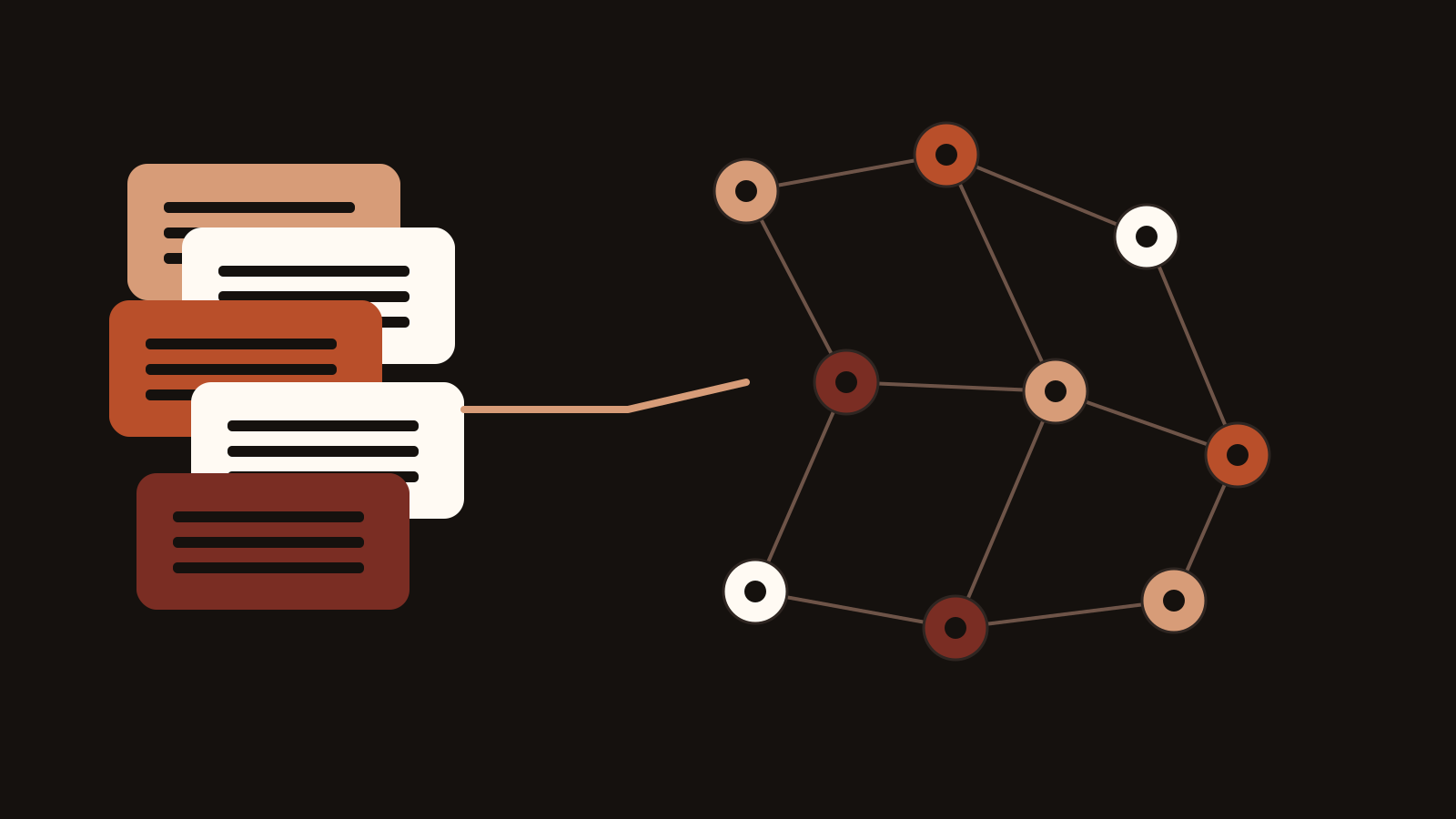
An AI company knowledge base is not just a folder of documents connected to a model. It is a curated layer of business context that makes policies, examples, definitions, customer knowledge and operating standards usable inside real workflows.
What is an AI company knowledge base?
An AI company knowledge base is the organized information an AI workflow can use to understand how the business operates. It can include policies, SOPs, offer details, customer definitions, approved examples, process documentation, internal terminology, product information and other material that helps the system produce work in context.
The important word is organized. A company may already have thousands of files, messages and pages, but that does not mean it has a usable knowledge base. Information can be duplicated, outdated, contradictory or too broad for a specific role.
A strong knowledge base is therefore less about uploading everything and more about deciding what the AI should treat as authoritative for a particular job.
Why company context is the difference between generic AI and useful AI
Without company context, AI can produce generally reasonable work. It can write a follow-up, summarize a meeting or answer a support question. What it cannot know is how your company defines a qualified lead, which policy applies to this customer, what tone is acceptable, which exception has already been approved or what a good internal report looks like.
That gap is why teams often experience the “blank chat” problem. Every new task begins with another explanation of the business. A connected knowledge layer lets the workflow begin closer to the point where a trained employee would begin.
What should go into an AI knowledge base?
Offers and services
Document what the company sells, who it is for, what is included, what is not included and how the business describes the value. This context matters for sales, support and content workflows.
Customer definitions
Include ideal customer profiles, segments, account tiers, common needs and terminology. If different customer types receive different handling, make that difference explicit.
Policies and operating rules
Refund rules, escalation criteria, approval limits, response standards and other recurring policies should be current and easy to identify as authoritative.
SOPs and process maps
AI works better when it understands not only what the company knows but how the company does the work. A process map can be more useful than a long document because it shows sequence, ownership and exceptions.
Examples of good work
Examples communicate standards that are difficult to express abstractly. Good customer emails, briefs, reports, proposals and handoffs can teach the system what the finished output should feel like.
Internal language
Businesses develop their own definitions. A “qualified lead,” “priority account” or “ready project” may mean something specific internally. Capture those definitions so the AI does not substitute generic assumptions.
What should not go into the knowledge base by default?
More data is not always better. Old documents, drafts that were never approved, personal notes, duplicated policies and irrelevant material can make retrieval less reliable. Sensitive information should also be included only when the role genuinely requires it and the access model supports it.
A useful knowledge base follows the principle of minimum relevant context: give the workflow enough information to do the job well, but do not make every piece of company data available simply because it exists.
How to structure the knowledge base
Organize information by function and authority. A support workflow should be able to distinguish current policy from background material. A sales workflow should know which offer description is official and which older deck is historical. A founder briefing workflow should prioritize current projects and account context over broad company archives.
Useful metadata can include owner, last-updated date, department, document type, audience and whether the content is authoritative. Even if the underlying system does not expose all of that metadata directly, thinking in those terms makes curation more disciplined.
Choose a source of truth instead of creating another copy
Whenever possible, keep company knowledge in the systems where the team already maintains it. The AI layer should reference or synchronize with the authoritative source rather than encouraging a second hidden version that becomes stale.
If the company already maintains policies in one documentation platform, that platform should remain responsible for those policies. The AI workflow can use them, but staff should not have to update the same rule in three places.
Retrieval quality matters as much as writing quality
When an AI answer is wrong, the failure may not be the reasoning model. The workflow may have retrieved the wrong document, missed a relevant policy or combined conflicting sources. That is why testing should inspect not only the final answer but the context used to produce it.
Create test questions that represent ordinary work and difficult work. Include cases where the correct answer depends on a narrow exception. If the system repeatedly retrieves irrelevant material, improve the knowledge structure before adding more instructions to the prompt.
A knowledge base needs an owner
Knowledge becomes stale as the business changes. Offers are updated, policies change, projects end and terminology evolves. Someone must own the process of keeping the AI context aligned with reality.
That owner does not need to manually inspect every document every week. They need a clear update path. When a policy changes, the authoritative source should be updated. When a document becomes obsolete, it should be removed or marked historical. When a new example becomes the standard, the workflow should be able to use it.
Build role-specific context instead of one giant company brain
The phrase “company brain” can make it sound as if every AI workflow should have access to everything. In practice, role-specific knowledge is often more reliable. The sales assistant needs different context from the customer-service assistant. The operations workflow needs different reporting definitions from the content workflow.
Shared company fundamentals can remain common, but each role should receive the material that helps it do its job. This improves relevance and reduces unnecessary exposure.
A practical build sequence
Start by selecting one role. List the questions and jobs that role must handle. For each job, identify the information a good employee would need. Locate the authoritative sources and remove obvious duplication. Then connect the minimum set of documents or data required for testing.
Run representative tasks and record where the system lacks context. Add missing knowledge deliberately rather than expanding access broadly. Over time, the knowledge base grows around proven needs.
Knowledge-base quality checklist
- Current policies are clearly distinguishable from old versions.
- Important business terms have explicit definitions.
- Examples reflect the current standard of work.
- Each category of content has an internal owner.
- Access is limited to what the role needs.
- Duplicate or conflicting sources are removed or resolved.
- Real-work test cases verify retrieval, not only final wording.
Frequently asked questions
Is an AI knowledge base the same as document storage?
No. Storage keeps files. A usable AI knowledge base identifies authoritative, current and relevant information so a workflow can retrieve the right context for a job.
Should I upload every company document?
No. Start with the minimum relevant sources for one role. Broad access can add noise, conflicting information and unnecessary risk.
How often should the knowledge base be updated?
Update it whenever the underlying business knowledge changes. High-change material such as offers, policies and active project information needs clearer ownership than stable background information.
Can different AI employees share one knowledge base?
They can share common company fundamentals, but role-specific context is usually more reliable. Each workflow should receive the information required for its responsibilities.
Knowledge access should follow the role
A knowledge base can contain sensitive commercial information even when it does not contain passwords or payment data. Pricing logic, customer notes, internal performance information and draft strategy should not automatically be available to every AI workflow.
Define access by role and consequence. A customer-support assistant may need approved policies and account history but not internal financial reporting. A founder briefing workflow may need broader visibility but still should not receive unrelated personal information. This keeps the knowledge layer useful without turning it into an uncontrolled data pool.
Build a permanent evaluation set
Keep a small library of representative questions and tasks that the workflow should answer correctly. Include ordinary questions, ambiguous questions, outdated-policy traps and cases that require an exception. Run that set again when the knowledge source changes or when the workflow is materially updated.
A permanent evaluation set gives the company a repeatable way to detect regressions. It also makes knowledge maintenance more objective because changes can be judged against known business scenarios rather than intuition alone.
The bottom line
A useful company brain is curated, role-specific and maintained. The goal is not maximum document volume. The goal is to make the correct business context easy for the workflow to retrieve when it has real work to do.
When the knowledge layer is treated as operational infrastructure rather than a one-time upload, every connected AI workflow becomes easier to improve because the company has a clearer source of truth.
Turn the process into a working AI system.
Send the role, systems and recurring work you want to improve. Rivoras can map the workflow and build the implementation around your business.